
A First Job Guarantee
How states can confront the looming AI disruption and rebuild the civic fabric at the same time – by turning service year into a good job.
by Daniel Squadron

In 1910, William James, perhaps America’s most influential Progressive Era philosopher, proposed a civilian national service program, built on the universal opportunity promised in the Declaration of Independence. He argued that “the military ideals of hardihood and discipline would be wrought into the growing fiber of the people” by universal service and that participants “would tread the world more proudly.” James was making the case from the point of view of the young men in his own “luxurious classes”: They’d “get the childishness knocked out of them,” he wrote, so that “women would value them more highly.”
His dated dating advice aside, today many more people in the U.S. enjoy the prosperous peace that James both hoped for and feared. Nearly forty percent of adults over 25 have a four-year college degree. Only five percent have served in the military. Even if we exclude other mission-driven professions – James cites priests and doctors, and we could add all uniformed civilian jobs held by those with a bachelor’s degree – more than a quarter of young people would fit his image of a privileged class that would benefit from service.
But, as James noted, it’s not just privileged young people who would benefit from a year of service. Today, the chasm of opportunity he described persists between those on a college track and those who go to work in their late teens. Shared service would help young people across geography and class develop a shared view of our country – what it means to be part of America and how we all could benefit from serving our common creed. It could also fuel economic mobility. Studies show that young people from low-income households who have exposure to those with higher incomes have an increased chance of economic mobility.
Those benefits alone would be enough to make universal service an imperative for state policymakers.
But offering a first job guarantee is more important than ever. With the specter of mass AI job losses, guaranteeing every young person a year of good employment would be a more affordable and politically palatable response to calls for universal income; in fact, beyond the wages earned, completion could also come with cost-effective benefits like investment bonds for young people who stay in the state where they served. In addition to the income earned, a first job guarantee in public service could diversify the ranks of those who choose uniformed service – such as the military, the police, or firefighting – which is today overwhelmingly eschewed by liberal young people on a college track.
The policy is simple:
One year of guaranteed employment in public service (let’s say $25/hr, growing with inflation) between the ages of 18 and 25, with an additional $10,000 investment bond available for redemption to anyone who stays in the state until they are 35. Employers could include any level of government and qualified community groups.
Unlike existing programs, this first job guarantee wouldn’t require young people to accept poverty wages, which make it vastly harder for those who aren’t subsidized by their parents to consider. And the marketing and management of the program would emphasize shared civic knowledge and commitment, beginning with the core principles of the Declaration of Independence through to the founding of the service program itself.
Claude made me a handy chart1 that shows what program goals would cost each state at different levels of participation:
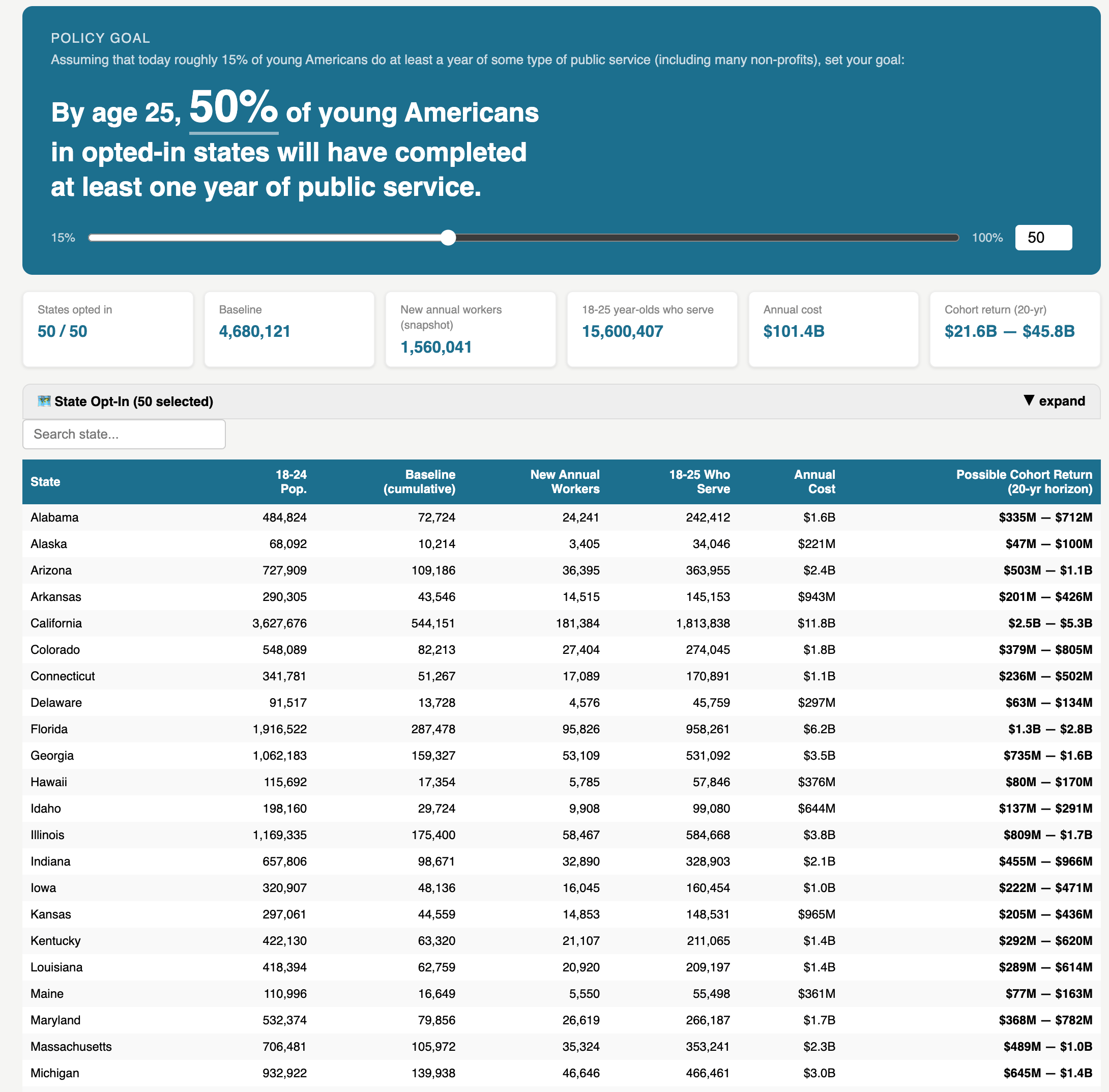
Remember, the largest costs are unlikely to accrue in the short-term – they’re only borne if the program is popular! Over time, it will only become popular if it’s delivering on its promise: better long-term employment prospects, greater social cohesion, and a more stable young adult population – exactly the things that will increase its fiscal returns to the state. And as more and more people would have participated, those benefits compound.
The (admittedly speculative) column on returns makes a few assumptions: Even in its first year, the program should reduce Medicaid and unemployment insurance costs. Stable employment early in a career can have a compounding effect on lifetime earnings and employment stability – the mirror of “scarring,” the finding that a year of unemployment at twenty-two reduces earnings by eight to ten percent for up to two decades. Further, a year of public service at a living wage should confer benefits beyond just employment, for instance developing the kind of professional networks that determine where people work for the rest of their lives. Finally, the combination of those social ties and the investment bond are designed to significantly increase a state’s retention of employable young adults, which would grow the tax base. Once potential availability of federal funds and possibility of public-private partnerships with nonprofits (excluded from the chart) are factored in, this program could even net the state dollars.
As with all new domestic policy ideas, proposing a big solution for Congress to take on is a fool’s errand. Rather than hoping that they’ll act in time to benefit today’s newborns when they become young adults, it’s smarter to assume those babies will become retirees before the federal government creates a new program.
The good news is that states are more likely to have jobs for many of the young people in a service year – and states actually act on big things. Some have already been moving toward versions of this, as TSF contributor Paul Monteiro wrote about from the perspective of Maryland and Andrew Doty wrote from the perspective of civic pride. Just last week, California announced a campaign to add 10,000 more young people to its Service Corps. These ideas each show that the politics of this concept has growing momentum.
It’s sometimes said that without debt financing, states simply don’t have the scale to launch ambitious new programs. But to put this in perspective, if fully half of a state’s young people participated it would cost about the same amount as the universal childcare program Mayor Mamdani has proposed for New York City, before considering the offsetting increases in revenue. If the program achieved an 80% participation rate – which would be a landmark achievement that fundamentally reset the relationship between states, young people, civic engagement, and employment – it would become one of the state’s central programs, though still a fraction of the state share of either education or healthcare.
I don’t mean to deny that offering a one-year first job guarantee in public service to every young American is expensive. It is.
The question, though, is, is it worth it?
Well, there’s no existing special interest that would lobby for it or benefit from it; for many elected officials, that reduces its value upfront. But if it’s true that the fraying of our politics and our nation is a crisis caused by a loss of civic engagement and pride in our nation’s creed, or if it’s true that we are staring down the barrel of a disruption to the workforce not seen since the Industrial Revolution, or if it’s true that we need a new common purpose in a fracturing democracy – then a one-year first job guarantee in public service is not just a valuable program; it is an urgent and uncompromising need.
And states can meet it.
Daniel Squadron is a cofounder of The States Forum. His book, The Fourth Branch: How State Government Can Save Our Union, is being released in June.
Helpfully, here are Claude’s notes on the chart:
State: The 50 US states. Use the opt-in panel to model a subset of states.
18-24 Pop.: Estimated population of residents aged 18-24, based on Census Bureau state age data applied to current state population figures.
Baseline (cumulative): Estimated number of young people in each state who currently complete at least one year of public service – including military, government, and nonprofit work – before age 25. Assumes 15% of the 18-24 population, based on analysis of BLS employment data and military service rates.
New Annual Workers: The number of additional young people serving at any given moment under the program, above the existing baseline. Because the program is a one-year commitment spread across seven age cohorts (18-24), only one-seventh of participants are actively serving at any time. Scales linearly with the participation rate set by the slider.
18-25 Who Serve: The total number of young people in each state who will have completed at least one year of public service by age 25 under the program, including both the existing baseline and new program participants. This is a cumulative cohort figure, not a snapshot.
Annual Cost: The estimated annual cost of employing the new annual workers, at $25/hour for a full work year plus a 25% benefits multiplier. Does not include the investment bond or program administration costs.
Possible Cohort Return (20-yr horizon): The estimated fiscal return to the state generated by one annual cohort of new program participants over 20 years, including: reduced Medicaid costs, increased income tax revenue from higher lifetime earnings, reduced unemployment insurance expenditures, and improved retention of young adults in the state tax base. The low end reflects conservative assumptions; the high end reflects the maximum defensible range. These are estimates based on published labor economics research and should be treated as directional rather than precise.